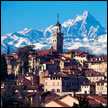
Saluzzo is a small Piedmontese town, one of this little centre where you can still feel the influence of the Paris atmosphere typical of XIX century Turin, when it used to be the capital of Piedmont Reign. But Saluzzo, once upon a time, was itself a capital: for four centuries its was the centre of a marquisate supporting trade, elegance and art.
Since 1142 the Saluzzo Marquisate founded its independence on a wise policy of alliance between France and Savoia. The late gothic treasures, that is the most meaningful monuments in town, show the beauty and richness of its court. Castles, abbeys, villages and parish churches in its territory are very important evidences of the richness in art and history not only inPiedmont .
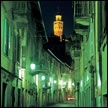
Saluzzo is placed in south-west Piedmont and enchants the one who comes here by chance thanks to its streets, alleys, stairs and arcades. Among the main monuments, we can find the Cathedral, an example of late Lombard gothic style, one of the widest in Piedmont. The imposing and severe inside keeps little treasures like the polypych in walnut with eight partitions by the Flemish Hans Clemer, the Baroque high altar dedicated to the Virgin Mary received into the Heaven, the marble backside of the first sixteenth century with The Nativity, The Exodus, Saints Peter and Paul, The Annunciation and The Resurrection. Up at the Castle the architectural landscape shows the Palazzo della Zecca, the old Town Hall with its square tower, the Palazzo delle Arti Liberali with its sixteenth century frescos. The imposing Castile dominating the street went to ruin then it was restored and transformed into a prison by Carlo Alberto, today it is considered in an important restoration project. The Church and the nearby San Giovanni cloister show good evidence of the marquisate period. The Gothic ensemble is broken by the Baroque Madonna del Rosario insert in the altar, while the inside decoration of the apse in an exceptional example of Gothic flaming in Burgundian style. Not far away from the church, Casa Cavassa - XV and XVI centuries - where pieces of furniture, frescos, paintings and works by Hans Clemer are exposed. We should not forget the house where Silvio Pellico was born and the baroque San Bernardo church.
Along the road going to Val Varaita we can find the Manta Castle, an imposing medieval fortress, which became a luxury residence in XV century: inside of them there are a large hall and the baron room decorated by frescos, a work by Jaquerio and Aiuti, representing Nine brave men, Nine heroins and the Youth Source.
Going from Saluzzo to Barge you have to visit the Staffarda abbey, established in the first middle of XII century by Cistercians monks. In 1750 thanks to the papal bull of Benedetto XIV, the Abbey was given to the Orders of Saints Maurizio and Lazzaro. The abbey considers the Church with the elegant cloister with little twin columns (preserved only north and south) and the monastic buildings (to be noticed are the guest-rooms, the refectory, the capitulary room) and the nine farmsteads. |